



How to Lose Weight with Chinese Medicine
An integrative approach that goes beyond the scale
Traditional Chinese Medicine • Sustainable Weight Loss • Lisbon
If you’ve tried various diets, followed plans with discipline and still feel your body “resists,” you’re not alone. For many people, the difficulty in losing weight isn’t about lack of willpower or effort — but in how the body responds.
Today we know, both from science and clinical practice, that sustainable weight loss is a complex process involving metabolism, hormones, nervous system, digestion, sleep and emotional state. This is precisely where Traditional Chinese Medicine (TCM) offers a different and complementary approach.
Excess weight: more than an aesthetic issue
Excess weight is associated with increased risk of type 2 diabetes, hypertension, cardiovascular disease and some types of cancer. In Portugal, INSEF data indicates that more than two-thirds of the adult population has weight above what is considered healthy.
However, reducing the issue to “eat less and move more” ignores fundamental factors that, in real life, determine the success or failure of any plan.
Why “eating less” doesn’t solve everything
In clinical practice, we frequently observe that difficulty in losing weight is associated with:
- Insufficient or irregular sleep, which alters appetite hormones (ghrelin and leptin)
- Chronic stress, with persistent increase in cortisol and tendency to accumulate abdominal fat
- Emotional hunger, as a response to anxiety, frustration or fatigue
- Persistent fatigue, which makes regular movement difficult
- Slow digestion and retention, with sensation of heaviness, abdominal distension or constipation
Chinese Medicine acts precisely on these factors, creating more favorable internal conditions for the body to function in a balanced way again.
BMI: an incomplete reference
Body Mass Index (BMI) continues to be used as a reference:
- 25–29.9 → Overweight
- ≥30 → Obesity
However, BMI doesn’t distinguish muscle mass from fat mass, nor does it assess fat distribution. Visceral abdominal fat is a much more relevant indicator of cardiometabolic risk.
At Five Clinic, assessment goes beyond the scale and includes: Chinese Medicine diagnosis, body composition assessment, lifestyle analysis, namely sleep patterns, stress and eating behavior.
How Chinese Medicine understands excess weight
In TCM, excess weight is not an isolated problem, but the manifestation of specific energetic patterns that guide treatment in a personalized way.
Spleen-Pancreas Deficiency (Pi)
Associated with slow digestion, fluid retention and intense desire for sweets.
Liver Qi Stagnation (Gan)
Related to stress and emotional eating.
Yang Deficiency (especially Kidney)
Associated with sensation of cold, deep fatigue and slow metabolism.
This reading allows treating the cause, not just the symptom.
What Chinese Medicine can integrate into a weight loss plan
Acupuncture — metabolic and neuroendocrine regulation
Acupuncture acts as a systemic regulation tool, influencing the autonomic nervous system, the neuroendocrine axis and metabolic processes. By reducing chronic stress, improving sleep quality, modulating appetite and optimizing digestion, it creates more favorable internal conditions for weight loss.
In clinical practice, this regulation translates into greater metabolic efficiency, less low-grade inflammation and better capacity of the body to use and balance energy — not just “willpower” to follow a plan.
Auriculotherapy — active regulation of appetite and stress
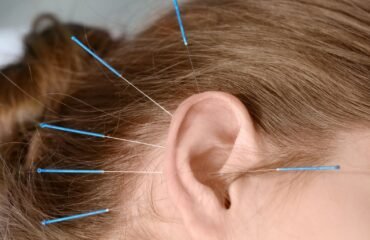
Auriculotherapy is a therapeutic microsystem with neurophysiological basis. Stimulation of specific ear points can influence appetite, stress response, autonomic nervous system and digestive and emotional axes.
Beyond reinforcing food awareness in daily life, it acts as an active regulation tool, especially useful in cases of compulsive eating, anxiety and emotional instability.
Lipolytic acupuncture — complementary local action
In some cases, lipolytic acupuncture techniques can be integrated, with local action on localized fat.
This approach can:
- Stimulate microcirculation
- Facilitate local lipolysis processes (fat breakdown in adipocytes)
- Improve tissue quality
- Reduce fibrosis and irregularities
Lipolytic acupuncture doesn’t replace the systemic work of Chinese Medicine. The best results emerge when used as a complement, integrated into a plan that includes metabolic, digestive and emotional regulation.
Chinese Dietetics — less diets, more system
Chinese Dietetics is not a restrictive diet. It’s a system based on regularity, digestibility and adaptation to individual constitution.
Fundamental principles:
- Reduce foods that promote inflammation and cravings
- Favor cooked foods when digestion is fragile
- Stabilize meal times to regulate appetite and sleep
Movement: the exercise you can maintain
Walking, Qi Gong, Tai Chi, swimming or other gentle practices. The goal is not to “burn calories,” but to create a functional body with energy to sustain the plan long-term.
Other complementary approaches
Tui Na: reduces tension and pain, facilitating regular movement
Chinese herbal medicine: digestive and metabolic support, with individualized prescription
Moxibustion: indicated in cold patterns and Yang deficiency
What about Ozempic, Wegovy and other GLP-1s?
Medications like semaglutide can be useful in supervised medical context. However, evidence shows that after discontinuation, it’s common to regain much of the lost weight if metabolic, behavioral and emotional factors aren’t addressed.
Chinese Medicine can act as a complement, helping to:
- Reduce digestive side effects
- Sustain energy and digestion
- Prepare a more balanced discontinuation
- Work on stress, sleep and eating patterns
The goal is not to lose weight fast — it’s to recover regulation
The most effective long-term approach is one that:
- ✓ Improves sleep and stress management
- ✓ Organizes digestion and eating routine
- ✓ Reduces cravings
- ✓ Facilitates consistent movement
- ✓ Tracks body composition, not just the scale
Chinese Medicine acts precisely on these pillars.
Schedule Assessment Consultation
First consultation includes Chinese Medicine diagnosis, body composition assessment and personalized plan
Frequently Asked Questions
Does acupuncture make you lose weight by itself?
Acupuncture doesn’t act as an isolated shortcut. Its main action is to regulate the nervous, hormonal and metabolic system, creating more favorable internal conditions for weight loss. In some cases, local techniques like lipolytic acupuncture can be integrated. The best results emerge when it’s part of an integrated and personalized plan.
How many sessions are needed?
It depends on individual pattern and goals. Usually an initial cycle of 8 to 12 sessions is recommended, with frequency of 1 to 2 times per week, followed by maintenance as needed.
Is Chinese Dietetics very restrictive?
No. It’s not based on calorie counting or rigid prohibitions. The focus is on food adaptation, preparation, temperature and timing, respecting individual constitution.
Can I do Chinese Medicine if I’m taking weight loss medication?
Yes, as long as your doctor is informed and the TCM professional knows all medications. TCM can be a valuable complement, especially to manage side effects and support sustainable discontinuation.
How much weight can I lose?
The focus should be on improving metabolic health and body composition. Rapid losses rarely sustain. A gradual reduction of 0.5-1kg per week, accompanied by improvements in sleep, digestion and energy, tends to be more sustainable long-term.