



Sleeping well, in the light of Chinese Medicine
Sleeping well, in the light of Chinese Medicine
Sleep as a pillar of healthy longevity
Never has so much been said about sleep — and yet we have never slept so badly. Between the ever-on screen, days that no longer have an end time and a mind that never seems to leave “alert mode”, sleeping has become, for many people, more of a challenge than a rest. And yet, long before polysomnography or apps that monitor sleep existed, Traditional Chinese Medicine (TCM) — recognised by the World Health Organization (WHO) as an effective medical system for treating a range of conditions — already knew how to read, with remarkable precision, the signs that determine whether we sleep well or badly.
What is interesting is that this ancient reading remains, today, surprisingly aligned with what sleep science confirms: that sleeping is not simply “switching off”, but an active process, prepared throughout the whole day.
01Yin and Yang: the mechanism behind every night
One of the simplest — and most useful — pillars of TCM for understanding sleep is the relationship between Yin and Yang. During the day, Yang predominates: energy, movement, mental activity, light. At night, Yin should predominate: stillness, withdrawal, darkness, inner nourishment. Sleeping well is, essentially, the ability to move from one state to the other — to “switch off” the Yang accumulated throughout the day and allow Yin to settle in. When this transition fails — because Yang remains active after night has fallen, whether from too much mental work, stimulants, screens or unprocessed emotions — the body stays on alert and sleep does not settle easily, or settles lightly and is interrupted.
02The Heart, the Shen, and why the mind won’t “switch off”
For TCM, sleep depends directly on the Heart — not just as a physical organ, but as a system that houses the Shen, a concept we can loosely translate as mind or spirit, and which is responsible for consciousness, memory and sleep itself. When the Heart is well nourished — with Blood and Yin — the Shen has “somewhere to rest” during the night. When it is weakened or disturbed, whether by prolonged stress, excessive worry or physical exhaustion, the Shen is left without an anchor, and this is where the most common patterns of sleep disturbance arise: difficulty falling asleep, shallow sleep, excessive dreaming or waking in the middle of the night. This is also why, in clinical experience, so few cases of insomnia are resolved by “willpower” alone — the root often lies in how the whole day treated the Heart and the mind, long before the person goes to bed.
03The organ clock: why we always wake at the same time
One of the most fascinating — and clinically useful — aspects of TCM is the so-called energetic organ clock: the idea that, over twenty-four hours, vital energy circulates with greater intensity through a different organ every two hours. This clock helps explain why so many people wake, night after night, at roughly the same hour — a pattern that conventional medicine tends to put down to chance, but which in TCM points to a specific organ asking for attention. Waking between 1 am and 3 am typically points to the Liver and emotional management; between 3 am and 5 am, to the Lungs and to processes of grief or undigested sadness; between 5 am and 7 am, to the Large Intestine. Recognising this pattern does not replace a clinical assessment, but it is often a sign that guides the diagnosis.
04What to do, in practice
The good news is that, just as TCM precisely identifies the origin of the imbalance, it also offers concrete, accessible tools to correct it — many of them simple to fit into everyday life.
Acupressure before bed
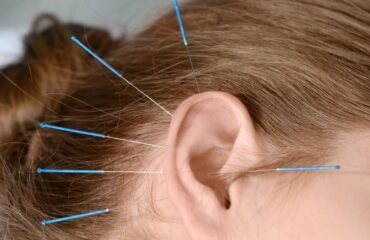
Three points are particularly effective and can be stimulated at home: Shenmen (HT7), on the wrist crease on the little-finger side, known as the “Spirit Gate” for calming the Heart; Sanyinjiao (SP6), four finger-widths above the inner ankle bone, which nourishes Yin and soothes the emotions; and Anmian, behind the ear, used specifically to induce sleep. Press each point gently, in circles, for one to two minutes, breathing slowly.
Food that calms the Shen
Certain foods are traditionally associated with a calming effect on the mind: lotus seeds, Chinese dates (jujube), oats and whole grains, which gently nourish the Spleen and quiet the spirit; and foods that nourish Yin and Blood, such as cherries, grapes, leafy green vegetables and black sesame seeds. Conversely, coffee, green tea, excessively spicy food and heavy evening meals tend to stir up Yang precisely when the body should be winding down.
Respect the rhythm of the day
Perhaps the most underrated teaching of TCM is this: sleep is not solved at night, it is solved throughout the whole day. Getting up and going to bed at regular times, exposing yourself to natural light in the morning, moving your body during the day and avoiding stimulants from early afternoon are ways of respecting the natural cycle between Yang and Yin — and, as a result, easing the transition into sleep at night.
Create a transition ritual
Thirty to sixty minutes before bed, dimming artificial light, putting screens away and adopting a small ritual — a warm tea, some gentle stretches, writing freely about whatever is on your mind — signals to the nervous system that the day is over. It is, in the language of TCM, the moment to invite Yin to settle in.
Sleep is not solved at night, it is solved throughout the whole day.
05An approach that treats the cause, not just the symptom
What distinguishes TCM from many quick fixes for sleep is precisely this: it does not simply “switch off” the symptom, it seeks to understand why the body, in that particular person, cannot move naturally between activity and rest. At Five Clinic, this individualised reading — through assessment of the pulse, the tongue and personal history, integrated with a current clinical perspective — makes it possible to design treatment plans truly tailored to each pattern, instead of generic formulas.
Sleeping well is not a minor detail of health. It is the foundation on which everything else is built — energy, mental clarity, emotional balance and immunity. And, often, the way to get there begins with understanding your own inner rhythm better.
Professional Licence in Chinese Medicine No. 006569 and Professional Licence in Acupuncture No. 0500378, issued by the Central Administration of the Health System, IP (ACSS)
ERS No. 39558/E166752
Article published in Saúde Actual magazine (September/October). The content is for information purposes and does not replace an individual clinical assessment.